

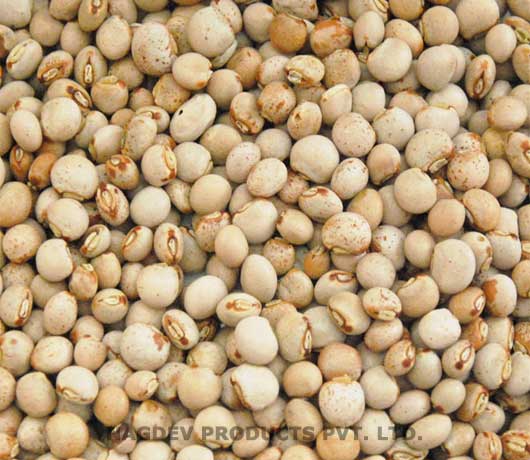
Pigeon Pea

Name: Pigeon Pea
Origin:  India
Shelf Life: 1 Year From Production Date.
Storage Condition: Cool Dry (20 C)
Specification: Detail Specification Will Be Provided Upon Request.
Description :
Pigeon pea, Cajanus cajan, is a perennial shrub in the family Fabaceae grown for its edible pods and seeds. Pigeon pea is a highly branched shrub with a woody base, slender stems, and trifoliate leaves. The plant leaflets are oblong or elliptical in shape and the leaves are alternate and arranged spirally on the stems. The plant usually produces yellow flowers, but they can be yellow with streaks of purple or red. The flowers are produced on racemes of 5–10 flowers. The seed pods are flat and either straight or sickle-shaped and measure 5–9 cm (2–3.5 in) in length. Each pod can contain between 2 and 9 seeds which can be white, cream, brown, yellow, purple or black or mottled with any combination of these colors. Pigeon pea can reach 0.5–4.0 m (1.6–13.1 ft) in height and is usually grown as an annual, harvested after one season. It may also be referred to as red gram or congo pea and originates from India.

Uses :
Pigeon pea is one of the most important legumes grown in semi-arid tropical regions and young seeds are consumed fresh as a vegetable or can be allowed to mature before drying and eating as a pulse. The seed pods are also edible and are eaten as a vegetable. The leaves and seed husks of the plant can be used as an animal feed.

Health Benefits:
Helps in weight loss Pigeon peas have saturated fats, low-calorie amount and cholesterol. The dietary fiber content in the legumes helps you to avoid the need to constantly eat or snack because it keeps the stomach full for a longer period of time. The nutrient and the dietary fiber content helps to boost your metabolism and curbs the unnecessary weight gain.

Description

Description :
Pigeon pea, Cajanus cajan, is a perennial shrub in the family Fabaceae grown for its edible pods and seeds. Pigeon pea is a highly branched shrub with a woody base, slender stems, and trifoliate leaves. The plant leaflets are oblong or elliptical in shape and the leaves are alternate and arranged spirally on the stems. The plant usually produces yellow flowers, but they can be yellow with streaks of purple or red. The flowers are produced on racemes of 5–10 flowers. The seed pods are flat and either straight or sickle-shaped and measure 5–9 cm (2–3.5 in) in length. Each pod can contain between 2 and 9 seeds which can be white, cream, brown, yellow, purple or black or mottled with any combination of these colors. Pigeon pea can reach 0.5–4.0 m (1.6–13.1 ft) in height and is usually grown as an annual, harvested after one season. It may also be referred to as red gram or congo pea and originates from India.

Uses :
Pigeon pea is one of the most important legumes grown in semi-arid tropical regions and young seeds are consumed fresh as a vegetable or can be allowed to mature before drying and eating as a pulse. The seed pods are also edible and are eaten as a vegetable. The leaves and seed husks of the plant can be used as an animal feed.

Health Benefits:
Helps in weight loss Pigeon peas have saturated fats, low-calorie amount and cholesterol. The dietary fiber content in the legumes helps you to avoid the need to constantly eat or snack because it keeps the stomach full for a longer period of time. The nutrient and the dietary fiber content helps to boost your metabolism and curbs the unnecessary weight gain.