
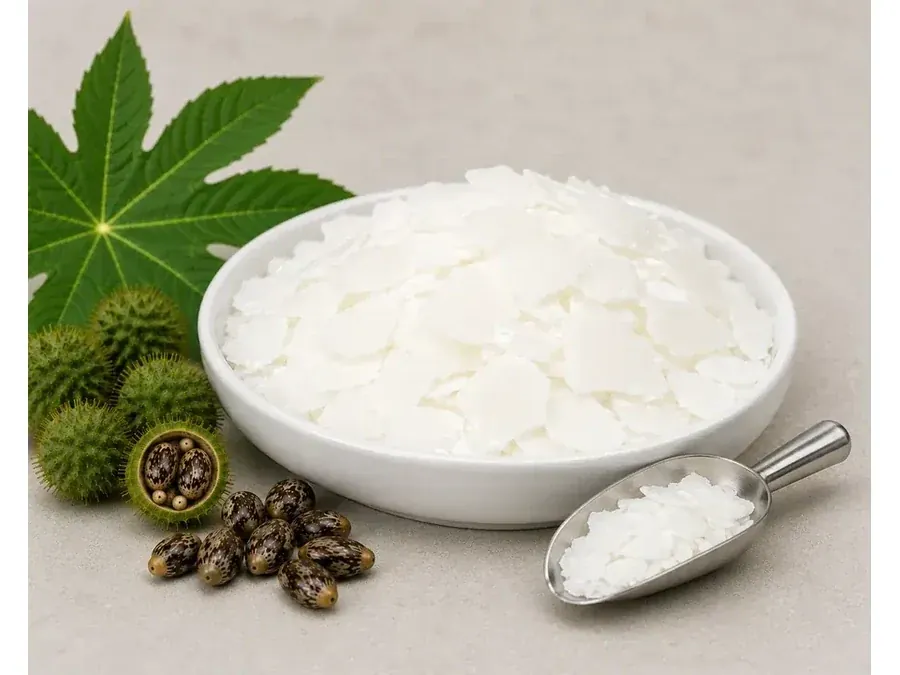
Hydrogenated Castor Oil (HCO)
Hydrogenated Castor Oil (NDEVWAX™ HCO) is a hard, high-melting white vegetable wax in regular commercial supply. It is used as a thickener in lithium greases, a rheology modifier in coatings, and a lubricant in PVC extrusion, supplied from our plant at Deodar, Gujarat, with a COA per lot.
Key Technical Facts
| Physical Form | Solid (White Flakes / Powder) |
|---|---|
| Key Specifications | Appearance: White Flakes · Melting Point, °C: 84.0 – 88.0°C · Iodine Value, g I₂/100g: 3.0 Max · Saponification Value, mg KOH/g: 176 – 185 |
| Primary Applications | Lithium Complex Lubricating Greases · Thixotropic Rheology in Coatings · PVC Extrusion Lubrication · Cosmetic Sticks & Wax Polishes |
Typical specification (indicative)
Specification limits; results reported on the COA for each lot.
| SR NO | TEST PARAMETER | SPECIFICATION LIMIT |
|---|---|---|
| 1 | Appearance | White Flakes |
| 2 | Melting Point, °C | 84.0 – 88.0°C |
| 3 | Iodine Value, g I₂/100g | 3.0 Max |
| 4 | Saponification Value, mg KOH/g | 176 – 185 |
| 5 | Acid Value, mg KOH/g | 3.0 Max |
| 6 | Hydroxyl Value, mg KOH/g | 155 – 165 |
| 7 | Moisture & Volatile Matter, % | 0.10 Max |
| 8 | Residual Nickel, ppm | 10 Max |
Values are typical for this grade. Results for each lot are reported on its COA; specifications can be agreed per contract.
Applications
Commercial and industrial applications for Hydrogenated Castor Oil (HCO) supplied from our Deodar plant.
Lithium Complex Lubricating Greases
Forms the structural thickener matrix in automotive chassis, wheel bearings, and industrial machinery greases.
Learn more →Thixotropic Rheology in Coatings
Functions as an anti-sagging and anti-settling agent in solvent-borne architectural paints, industrial epoxies, and marine coatings.
Learn more →PVC Extrusion Lubrication
Acts as an efficient internal and external lubricant in rigid PVC pipe and profile extrusion, improving melt flow and surface gloss.
Learn more →Cosmetic Sticks & Wax Polishes
Provides hardness, temperature stability, and clean release in cosmetic lipsticks, deodorant sticks, and protective industrial wax polishes.
Learn more →Packaging & Quality Documentation
Packaging Formats & Dispatch
Packaging options:
Quality Assurance & Lot Documentation
Each lot is tested and supplied with a Certificate of Analysis (COA).
- Batch Certificate of Analysis (COA): Issued per lot verifying specific batch parameters.
- Technical Data Sheet (TDS): Technical parameter guidance and standard limits.
- Safety Data Sheet (SDS): handling and safety information.
- Operational Dispatch: Dispatched directly from our manufacturing plant in Deodar, Gujarat.
Frequently Asked Questions
What chemical transformation occurs during the production of castor wax?
Refined castor oil is reacted with molecular hydrogen over a nickel catalyst to saturate all double bonds, creating tri-hydroxystearin wax with melting point 85–88°C.
What physical parameters define NDEVWAX™ HCO flakes?
Sharp melting point of 85°C to 88°C, iodine value under 3.0 g I2/100g, acid value below 3.0 mg KOH/g, and hydroxyl value of 155 to 165.
What physical forms are available for hydrogenated castor oil?
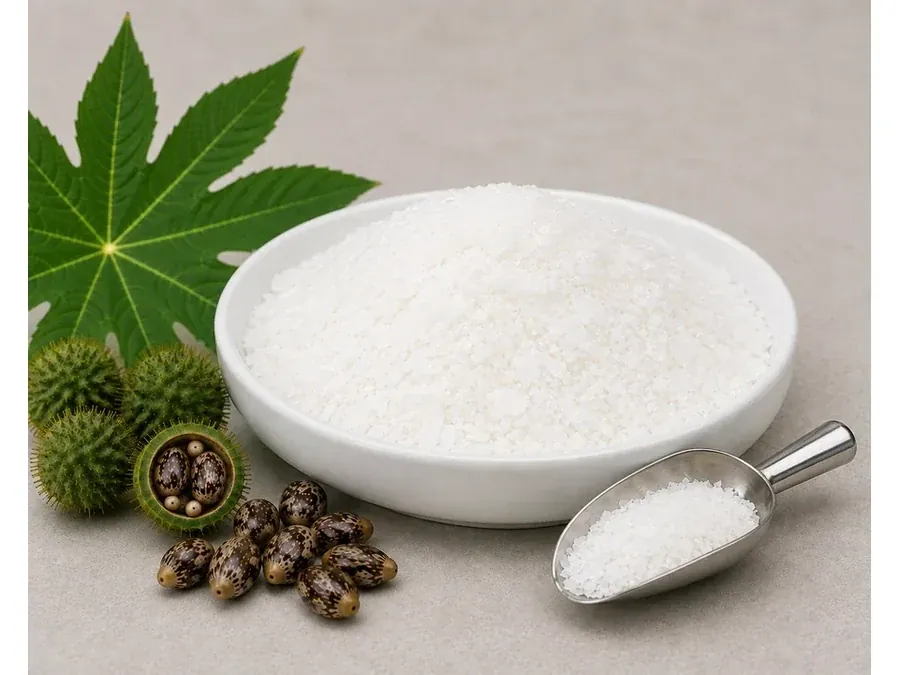
Supplied as flakes or micronized powder as specified per order, packaged in 25 kg bags with inner poly liner or 500/1000 kg bulk bags.
How are HCO wax flakes protected during ocean transport?
Packaged in 25 kg multi-wall paper sacks with inner polyethylene moisture barriers or 500/1000 kg PP jumbo bags. Container payloads in a 20ft FCL are typically 16–18 MT palletized and stretch-wrapped, or 20 MT loose floor-stuffed.
What is the difference in chemical structure between HCO and hydroxylated fatty acids?
HCO is a complete triglyceride wax ester containing glycerin, whereas 12-HSA is a split, isolated free fatty acid used directly in soap making.
Related Castor Products & Derivatives
Other castor oil grades and derivatives from the Nagdev range.


Order commercial volumes or request samples
Connect directly with our commercial desk in Gandhinagar or technical plant team in Deodar, Gujarat.