
Castor Seed Pressing & Oil Mill Flow
From certified seed receiving and QC sampling through automated screen cleaning to high-pressure mechanical expelling, yielding unrefined Commercial Castor Oil and expeller castor cake (typically 8–10% residual oil) for organic soil conditioning.
📋 Stage-by-Stage Engineering Breakdown
Seed receiving & QC sampling
Direct farm-gate seed consignments from North Gujarat undergo gross and tare verification and QC sampling. Quality inspectors draw composite core samples for rapid lab analysis of seed moisture, foreign matter, and seed purity.
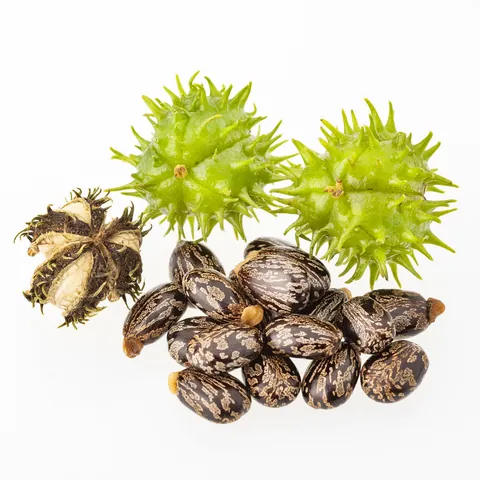
Multi-Deck Cleaning & Byproduct Handling
Vibratory screens, rare-earth permanent magnetic drums, and de-stoners remove stems, stones, and iron tramp metal. Light husks and pods are aspirated and conveyed directly to covered storage facilities.
Continuous High-Torque Screw Expelling
Cleaned seeds are conditioned and crushed in heavy-duty mechanical screw expellers . Approximately 40% of the seed mass is extracted as unrefined commercial crude castor oil, while the remaining approximately 60% forms expeller cake containing typically 8–10% residual oil.
Expeller Cake Conditioning & Bagging
Hot expeller cake discharged from the press barrels is gently cooled and conditioned into consistent flakes. Containing ~8–10% residual oil and typical 4.0–4.5% organic nitrogen, this cake serves as an organic slow-release fertilizer and soil conditioner.
Extraction Mass Balance (1,000 kg Cleaned Seed Basis)
Theoretical & Plant Operating Metrics| Stream / Component | Type | Mass Balance (kg) | Composition & Purity | Primary Industrial Destination |
|---|---|---|---|---|
| Cleaned Castor Seed Feed | INPUT | 1,000 kg | Farmgate Seed Feed (Cleaned) | Direct Farmer Sourcing from North Gujarat's castor belt (Banaskantha and Vav-Tharad region) |
| Primary Crude Castor Oil | PRODUCT | 400 kg (40%) | Unrefined, FFA 1.5%–2.0% | Sent to Clarification, Decantation & Refining |
| Castor Cake (Expeller Cake) | PRODUCT | 590 kg (59%) | Residual Oil ~8%–10%, Nitrogen 4.0%–4.5% (typical) | Organic Soil Conditioner & Natural N-P-K Manure |
| Husks & Solid Debris | BYPRODUCT | 10 kg (1%) | Fibrous Biomass & Inert Dust | Covered Storage / Biomass Coproduct (Zero Fossil Emission) |
Castor Oil Chemical Refining Flow
Advanced degumming, foots sedimentation, high-vacuum thermal moisture stripping, Activated Bleaching Earth & Carbon adsorption, and hermetic vertical pressure leaf filtration producing FSG/BSS, PPG, and British Pharmacopoeia (Castor Oil BP) grades.
📋 Refining Operation & Quality Parameters
Decantation & Foots Recycle
Crude oil settles in continuous conical decanters where heavy mucilaginous gums and solid meal fines gravimetrically separate. Clarified supernatant moves forward to bleaching, while settled foots are continuously recycled back to the expellers for closed-loop recycled oil recovery.
Controlled Adsorption Chemical Dosing
Clarified oil is treated in an automated slurry dosing reactor with Hyflow filter aid (0.1%–0.3%) for leaf pre-coat, Tonsil / Galleon acid-activated bleaching earth (1.0%–1.5%) for chlorophyll/carotene removal, and Activated Carbon (0.75%–1.0%) for deep polyaromatic odor stripping.
High-Vacuum Thermal Bleacher
The oil slurry enters an agitated vacuum reactor operated at 95°C to 110°C under vacuum. Controlled agitation strips trace moisture to <0.25% while maximizing adsorptive interaction between clay active sites and coloring bodies.
Pressure Leaf & Security Polish Filtration
Bleached oil is pumped through vertical pressure leaf filters (VPLF) operating under pressure leaf filtration. Spent bleaching earth forms an impermeable cake and is vibrated dry. The crystal-clear oil passes through 5-micron security guard cartridges to ensure complete optical brilliance.
Refining Mass Balance (1,000 kg Crude Oil Basis)
Adsorption Reagent Ratios & Finished Yields| Process Stream | Type | Mass (kg) / Dosage | Analytical Specification | Industrial Utilization |
|---|---|---|---|---|
| Crude Castor Oil Feedstock | FEED | 1,000 kg | FFA 1.5%–2.0%, Moisture <0.50% | From Oil Mill Continuous Expelling |
| Tonsil Bleaching Earth & Carbon | REAGENT | 17.5 kg – 25.0 kg | High-surface active montmorillonite + Carbon | Adsorption of carotenoids & phosphatides |
| Refined Castor Oil (FSG / BSS) | PRODUCT | 960 kg (96%) | FFA <1.0%, Lovibond 20Y+2R, IV 82–90 | High-Grade Resins, Lubricants & Derivatives |
| Spent Bleaching Earth Cake | BYPRODUCT | 22 kg (2.2%) | Dry spent clay with adsorbed pigments | Safe industrial solid recovery / cement blending |
| Foots Recycle Stream | RECYCLE | 25 kg (Circular) | Suspended meal fines & heavy triglycerides | Recycled into Expellers (100% Oil Recovery) |
Castor Oil Derivatives & Co-Products Manufacturing
Controlled catalytic hydrogenation, alkaline hydrolysis, sulphuric acidulation, and spent lye vacuum distillation synthesizing Hydrogenated Castor Oil (HCO), Ricinoleic Acid, 12-Hydroxystearic Acid (12-HSA), and Refined Glycerin.
📋 Reaction Stoichiometry & Operating Conditions
Catalytic Hydrogenation to HCO Wax
1,000 kg of Refined FSG Castor Oil is reacted with technical hydrogen gas in the presence of supported Nickel catalyst at 140°C–180°C. Double bonds are selectively saturated, yielding hard white HCO wax.
Alkaline Hydrolysis
1,000 kg molten HCO is continuously fed into the hydrolysis reactor and reacted with 150 kg of 30% caustic soda (NaOH) solution. The triglyceride ester linkages are cleaved, producing sodium 12-hydroxystearate soap and releasing free glycerin in an aqueous medium.
Acidulation & 12-HSA Flaking
The soap is acidulated with 190 kg of 60% sulphuric acid (H₂SO₄) and washed with 400 kg demineralized water. The mixture separates cleanly into an organic fatty acid layer (940 kg 12-HSA chilled and flaked on rotary drums) and an aqueous spent lye layer containing glycerin and sodium sulphate.
Spent Lye Evaporation & Salt Recovery
The spent lye aqueous phase (92 kg Glycerin + 250 kg Na₂SO₄ + 850 kg H₂O) is treated and concentrated in multi-effect evaporators. Centrifugal crystallization separates 250 kg of Sodium Sulphate Anhydrous (under development), while the concentrated glycerin is distilled to produce 69 kg of Refined Glycerin (under development).
Derivatives Stoichiometric Mass Balance (1,000 kg FSG Basis)
Full Chemical Input / Output Material Accounting| Material Component | Stream Type | Quantity / Consumption | Stoichiometric Specification | Industrial Output / Application |
|---|---|---|---|---|
| Refined FSG Castor Oil Feed | RAW FEED | 1,000 kg | Iodine Value: 82 – 90 units | Feedstock for Catalytic Hydrogenation |
| Technical Hydrogen Gas (H₂) | REAGENT | 92 Nm³ (approx. 8.2 kg) | Purity > 99.9% H₂ gas | Selective double-bond saturation |
| Supported Nickel Catalyst | CATALYST | 1.2 kg / MT | Active reduced Nickel | Heterogeneous hydrogenation catalyst |
| Hydrogenated Castor Oil (HCO) | INTERMEDIATE | 1,000 kg (100%) | Iodine Value < 4.0, MP 84°C–88°C | Commercial Castor Wax / Feed for Hydrolysis |
| Caustic Soda (NaOH 30% Sol.) | REAGENT | 150 kg | 30% Aqueous Sodium Hydroxide | Alkaline ester bond hydrolysis |
| Sulphuric Acid (H₂SO₄ 60%) | REAGENT | 190 kg | 60% Technical Sulphuric Acid | Acidulation of sodium ricinoleate soap |
| Demineralized Wash Water | UTILITY | 400 kg | Conductivity < 10 µS/cm | Removal of trace salt and free acid |
| 12-Hydroxystearic Acid (12-HSA) | PRIMARY PRODUCT | 940 kg (94.0%) | Melting Point Min. 74°C, Acid > 175 | Multipurpose Lithium Complex Greases & Polymers |
| Handling / Moisture Losses | PROCESS LOSS | 19 kg (1.9%) | Evaporative moisture & filter wash | Process evaporation and scrubber venting |
| Refined Glycerin (USP / Tech) | CO-PRODUCT | 69 kg (6.9%) | Purity Min. 99.5%, Colour APHA < 20 | Pharmaceutical, Alkyd Resins & Cosmetics |
| Sodium Sulphate Anhydrous | CO-PRODUCT | 250 kg (25.0%) | Purity Min. 99.40% Na₂SO₄, White Crystal | Detergents, Glass & Textile Dyeing |
Explore the Castor Chemistry Tree
View our molecular reaction taxonomy mapping 4 stages of value addition from crude castor oil and expeller cake to ricinoleic acid, sebacic acid, bio-polyols, and specialty metallic stearates.
Launch Interactive Chemistry Tree →